




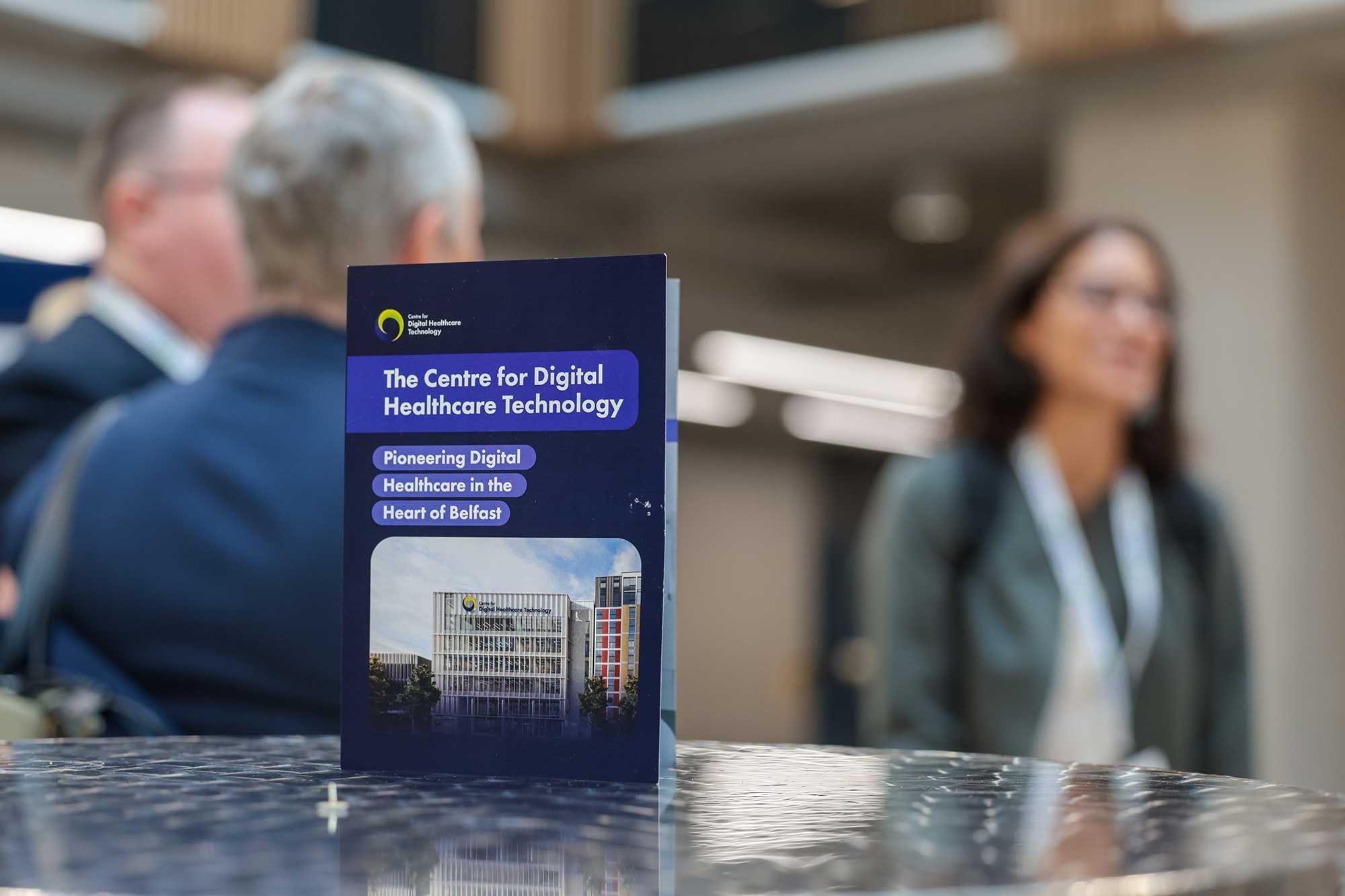
The Centre for Digital Healthcare Technology (CDHT) delivered a two-day conference at Ulster University’s Belfast campus to explore social care innovation in Northern Ireland.
Bringing together researchers, industry and frontline social care professionals and service users on 22-23 June 2026, this inaugural TESCI nationwide network event saw a two-day workshop approach used as a platform for co-creation to begin to address the region's acute social care challenges through the application of cutting-edge technology.
Technology demonstrations from the School of Computing and BT allowed visitors to see capabilities that are being developed locally that can support their organisations for new innovations.
Sponsored by Technology Enabled Social Care Innovation (TESCI), the event focused extensively on TESCI’s three core pillars: data-driven tools for workforce planning; predictive technologies to combat frailty and loneliness; and hardware innovations like robotics and smart sensors.
Setting the Vision: Co-Creation and Lived Experience
The workshop opened with a powerful statement from Ulster University and TESCI leadership, emphasising that technology in social care must be built with people, not just for them. This sentiment was echoed and ongoing work shared during a thought-provoking keynote address by Suara Cooperativa, who challenged attendees to reimagine engineering as a vital pillar of empathy and community wellbeing.
A major highlight of the opening day was the grounding of technical theories in real-world human experience. A series of themed presentations brought together academic researchers, social care providers and service users. By elevating lived experiences alongside data analytics and assistive hardware, the session underscored a critical truth: algorithms and sensors are only as effective as the human dignity they protect.
Interactive Design Sessions
Representatives from prominent local care provision organisations such as Bryson Care, including their service users, joined forces with industry engineers and academic researchers for an intensive design-thinking session.
Divided into multidisciplinary teams, participants tackled social care challenges and issues - some specific to Northern Ireland - which were pitched to a panel of innovation experts in a Dragon's Den-style session.
Day two shifted the focus toward long-term sustainability, policy impacts, and nurturing the next generation of talent through a dedicated Early Career Researchers (ECRs) workshop. Several ECRs presented their talent dedicated to healthcare technology in a poster display, which offered the attendees the opportunity to see ongoing investigations into social and healthcare challenges.
Key Findings and Outcomes:
As the event concluded, several key findings and actionable outcomes emerged as a blueprint for the future of social care in Northern Ireland:
1. Ethical, Human-Centric AI is Non-Negotiable
Predictive tools for tracking frailty and loneliness hold immense promise, but they must be implemented with transparent ethical frameworks. Co-designing these tools alongside organisations like Bryson Care ensures that privacy is maintained and technology acts as a bridge to human contact, rather than a replacement for it.
2. Interoperability and Data-Driven Workforce Planning
To ease the burden on social care staff, newly developed data tools must integrate seamlessly with existing Health and Social Care structures. Siloed data was identified as a major roadblock. Unifying these systems will allow for predictive workforce planning and better patient outcomes.
3. Scalable Hardware for Independent Living
Smart sensors, wearables and assistive robotics must move rapidly from the lab to the home. Industry partnerships forged at the workshop aim to lower the cost barrier of these hardwares, empowering users to age in place safely while alleviating pressure on residential care facilities.
4. Direct Funding Pathways for Rapid Prototyping
The bridging of academic research with immediate industry application backed by clear paths toward EPSRC funding, for example, is essential. The success of the Dragon's Den-style session proved that rapid, collaborative prototyping can drastically shorten the time it takes for an innovative idea to reach a vulnerable service user.
Dr Matias Garcia-Constantino, Research Associate for the School of Computing, said:
"It was a great experience to help organise and to participate in the TESCI 2-day conference at Ulster University. The event was supported by the Centre for Digital Healthcare Technology (CDHT). There were very interesting presentations and panels from academia, industry and social care delegates, as well as very productive co-creation sessions."
Professor Chris Nugent, Head of School of Computing, said:
"Hosting the TESCI two-day conference at Ulster University alongside the CDHT team underscores our core mission: breaking down silos to transform how care is delivered. Over these two days, we brought together some of the brightest minds across computing, data science, clinical practice, and social care to address real-world challenges.
By uniting industry leaders, academic researchers, and social care professionals under one roof, we aren't just discussing the future of assistive technology, wearables, and predictive AI, we are actively co-creating it. This collaboration is vital for building a sustainable, data-driven ecosystem that will drastically improve patient outcomes and support the workforce both locally in Northern Ireland and beyond."
Looking Ahead
The TESCI conference closed with new connections made, early project collaborations beginning to take shape, and ecosystem support from CDHT to keep this momentum alive. By breaking down the traditional silos between industry, academia and frontline care, Northern Ireland is uniquely positioned to pioneer a smarter, more compassionate health and social care ecosystem.
Find out more:
TESCI
Technology Network for Social Care Innovation is an EPSRC funded network which recognises technology can enhance the quality of social care services, making a real difference in the lives of individuals, their families, and the workforce providing care.
CDHT
The Centre for Digital Healthcare Technology (CDHT) acts as a facilitator, innovation and knowledge broker and a stimulus for ABC multidisciplinary collaborative partnerships that address clinical and healthcare challenges with world-class research & development, discovery and knowledge exchange.